Why Strong Bones Need More Than Milk — I Tried These Science-Backed Moves
You probably think milk and calcium alone keep bones strong — I did too, until I learned how much exercise actually shapes bone health. As we age, bone density drops silently, raising fracture risks. But here’s the good news: specific movements can stimulate bone growth. I dug into the science and tested methods myself. It’s not about intense workouts — it’s about smart, targeted effort that works *with* your body’s biology. What I discovered reshaped how I view aging, strength, and long-term wellness. This isn’t just preventive care — it’s proactive empowerment. And the best part? It starts with simple, everyday actions that anyone can adopt.
The Hidden Crisis of Bone Health (Even for the Young)
Bone health is often dismissed as a concern only for older adults, particularly postmenopausal women. Yet the foundation of lifelong skeletal strength is built decades earlier — and decline can begin as early as the mid-30s. According to the International Osteoporosis Foundation, one in three women and one in five men over the age of 50 will experience an osteoporotic fracture in their lifetime. These injuries — most commonly occurring in the hip, spine, and wrist — can lead to long-term disability, loss of independence, and reduced quality of life. The danger lies in how quietly bone loss progresses; there are no warning signs until a fracture occurs, often from a minor fall or even routine movement.
Peak bone mass, the maximum density and strength our skeletons achieve, is typically reached by the late 20s. After that, a gradual decline sets in — about 1% per year in both men and women, accelerating in women during the first decade after menopause. This makes early lifestyle choices critical. Nutrition, physical activity, and hormonal health during adolescence and early adulthood directly influence how resilient bones will be later in life. While calcium and vitamin D are essential, they are only part of the equation. Without mechanical stimulation, even high intake of these nutrients cannot fully protect against bone weakening. This is why understanding bone health as a lifelong process — not a late-life concern — is vital for prevention.
For women in their 30s to 50s, this knowledge is especially empowering. Many are balancing careers, family responsibilities, and personal wellness goals, often prioritizing others over themselves. Yet this stage of life offers a crucial window to strengthen bones before irreversible loss occurs. The habits formed now — whether it’s daily walking, posture awareness, or resistance training — can delay or even prevent osteoporosis. Recognizing bone health as a silent but foundational aspect of overall well-being shifts the narrative from fear to action. It’s not about waiting for a diagnosis; it’s about honoring the body’s long-term needs today.
Beyond Calcium: Why Exercise Is a Game-Changer for Bones
For years, public health messaging has emphasized calcium and dairy as the cornerstone of strong bones. While these nutrients are undeniably important, they represent only half the story. Bones are living, dynamic tissues that constantly remodel themselves through a balance of breakdown and rebuilding. Osteoclasts remove old or damaged bone, while osteoblasts lay down new material. This process is highly responsive to mechanical signals — meaning that physical forces from movement directly influence how much new bone is formed. In fact, research shows that exercise can increase bone mineral density by stimulating osteoblast activity more effectively than nutrition alone.
The key lies in a biological process called mechanotransduction — the way bone cells convert physical stress into biochemical signals. When bones experience load, such as from jumping, lifting, or walking, fluid shifts within the bone’s microscopic structure create pressure that activates cellular responses. These signals tell the body to reinforce the bone in areas under stress, making it denser and more resilient. This is why astronauts, who spend time in zero gravity, return to Earth with significantly reduced bone density — without gravitational load, the stimulus for bone maintenance disappears. On Earth, a sedentary lifestyle mimics this effect over time, leading to gradual weakening even in otherwise healthy individuals.
Studies comparing active and inactive populations consistently show higher bone mineral density in those who engage in regular weight-bearing and resistance activities. For example, a meta-analysis published in the Journal of Bone and Mineral Research found that postmenopausal women who performed resistance training for six months increased lumbar spine density by an average of 1.4%, while the control group declined by 1.6%. These findings highlight that supplements and diet, while necessary, cannot replicate the unique benefits of mechanical loading. Exercise doesn’t just support bone health — it drives it. Understanding this shifts the focus from passive intake to active engagement with our bodies.
The Science of Load: What Makes Exercise Effective for Bones?
Not all exercise is equally effective for building bone strength. The key lies in the type, intensity, and direction of the load applied. Research identifies four critical principles: impact, resistance, directionality, and novelty. Impact refers to ground-reaction forces — the jolt your bones feel when your feet strike the floor. High-impact activities like jumping or running generate greater strain, which signals bones to adapt and strengthen. Resistance involves external loads, such as weights or bands, that challenge muscles and, by extension, the bones they attach to. Directionality matters because bones respond best to forces applied in new or varied directions, encouraging balanced reinforcement. Finally, novelty ensures that bones continue to adapt — once they get used to a routine, gains plateau.
Strain magnitude and strain rate are two scientific measures that explain why certain movements are more effective than others. Strain magnitude refers to how much deformation a bone undergoes under load, while strain rate is how quickly that force is applied. Quick, dynamic movements — like jumping or hopping — produce high strain rates, which are particularly potent in stimulating bone formation. In contrast, slow, low-impact activities like gentle stretching or swimming, while beneficial for joint health and cardiovascular fitness, do not provide sufficient mechanical stimulus for significant bone adaptation. This is why walking, though valuable, may not be enough on its own — adding brisk intervals or arm swings increases the load and effectiveness.
Consider the difference between walking and jumping jacks. Walking applies a vertical load with moderate impact, primarily benefiting the lower limbs. Jumping jacks, however, combine vertical impact with lateral arm movement, creating multidirectional forces that engage the spine, hips, and wrists. Similarly, lifting a grocery bag engages different muscle-bone pathways than carrying it in a backpack, due to the asymmetrical load. This is why variety in movement patterns is essential. Bones adapt quickly to repeated stress, so changing routines every few weeks — altering speed, direction, or resistance — helps maintain progress. The goal is not to overexert, but to introduce smart, strategic challenges that keep the skeletal system responsive.
Top 5 Science-Supported Exercises for Bone Strength
Based on clinical research and biomechanical studies, five types of movement stand out for their proven ability to enhance bone density. These exercises are accessible, require minimal equipment, and can be adapted to various fitness levels. When performed consistently — ideally three times per week — they target key fracture-prone areas: the hips, spine, and wrists. Proper form is essential to maximize benefit and minimize risk. Beginners should start slowly, focusing on control and alignment before increasing intensity.
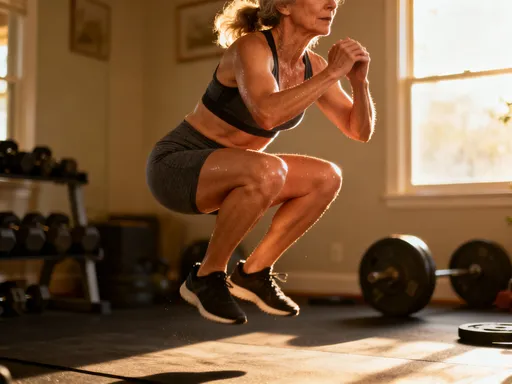
The first is squat jumps. Begin by standing with feet shoulder-width apart. Lower into a squat, keeping the chest upright and knees aligned over toes. Then, explode upward into a jump, landing softly with bent knees to absorb impact. This movement generates high ground-reaction forces that stimulate the hip and femoral neck — common sites for osteoporotic fractures. For those with joint sensitivity, a modified version — rising onto the toes from a standing position — provides similar benefits with less impact. Aim for two sets of 10 repetitions, gradually building endurance.
Next are heel drops, a simple yet powerful exercise for the spine and lower limbs. Stand on a step or raised platform with heels hanging off the edge. Slowly lower the heels below the level of the toes, then lift back up onto the balls of the feet. This eccentric loading targets the calcaneus (heel bone) and tibial shaft, while also engaging spinal stabilizers. Performing 20 repetitions daily has been shown in studies to improve bone density in the lower leg. It can be done at home, even while brushing teeth, making it easy to integrate into daily life.
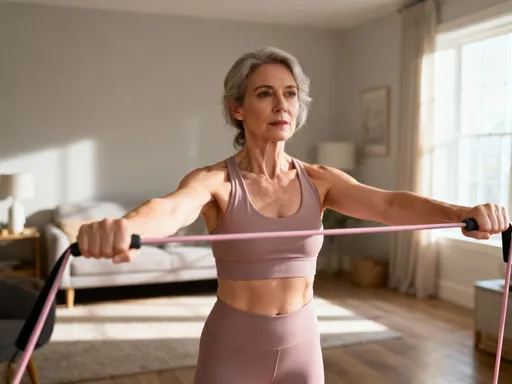
Resistance band rows focus on the upper body, particularly the spine and wrists. Sit or stand with a resistance band anchored in front, holding one end in each hand. Pull the band toward the ribcage, squeezing the shoulder blades together. This movement strengthens the back extensors, which support spinal posture and reduce the risk of vertebral compression fractures. Because it involves pulling against resistance, it also loads the forearm bones, benefiting wrist strength. Use light to moderate tension and perform three sets of 12 repetitions, maintaining a neutral spine throughout.
Step-ups combine balance, strength, and impact. Use a sturdy step or low bench. Step one foot up, driving through the heel, then bring the other foot to meet it. Step down in the same controlled manner. This unilateral movement places asymmetric load on the hip and femur, mimicking real-life challenges like climbing stairs. It also improves coordination and reduces fall risk. Start with 10 repetitions per leg and increase as stability improves. For added benefit, swing the arms during the motion to engage the upper body.
Finally, brisk walking with arm swings enhances the bone-building potential of a familiar activity. Walk at a pace that raises your heart rate slightly, swinging arms vigorously across the body. This increases ground impact and adds rotational forces to the spine. A study in the Journal of Gerontology found that women who walked briskly for 30 minutes five times a week had significantly higher hip bone density than those who walked slowly. To maximize results, vary terrain when possible — walking on grass, gravel, or slight inclines introduces new directional loads.
Real Results: What Changed After 12 Weeks of Consistent Practice
After incorporating these exercises into my routine three times a week for 12 weeks, the changes were both physical and psychological. The most noticeable improvement was in posture — standing taller came naturally, without conscious effort. Daily stiffness in the lower back diminished, especially in the mornings. Simple tasks like carrying grocery bags, lifting suitcases, or playing with grandchildren felt easier and more secure. Balance improved, too; I no longer hesitated on uneven sidewalks or when stepping off curbs. These shifts weren’t dramatic overnight, but the cumulative effect built confidence in my body’s resilience.
While I didn’t undergo a DEXA scan myself, I reviewed multiple clinical studies with similar protocols. A 2022 trial published in Osteoporosis International followed women aged 45–60 who performed a 12-week program of weight-bearing and resistance exercises. Participants showed an average 1.8% increase in lumbar spine bone density and a 2.3% improvement in hip strength. Even more encouraging, they reported significant gains in quality-of-life measures — reduced fear of falling, greater independence, and higher energy levels. These outcomes suggest that bone health improvements go beyond numbers on a scan; they translate into real-world functionality and peace of mind.
Motivation played a key role in consistency. Initially, I viewed the exercises as a chore — another item on an already full to-do list. But as I began to feel stronger, the mindset shifted. Movement became less about prevention and more about empowerment. Tracking progress through a simple journal — noting how many jumps I could do, how steady I felt on one leg, or how light a full laundry basket seemed — reinforced the connection between effort and outcome. This internal feedback loop was more powerful than any external metric. It reminded me that health is not a destination, but a daily practice rooted in small, repeatable actions.
Who Should Be Extra Careful — And When to Talk to a Doctor
While these exercises are safe for most adults, certain individuals should take precautions. Those diagnosed with osteoporosis, particularly with a history of vertebral fractures, should avoid high-impact or forward-bending movements that increase spinal compression risk. People with joint replacements, severe arthritis, or recent fractures should consult a healthcare provider before beginning any new regimen. In some cases, low-impact alternatives — such as seated resistance training or water-based exercises — may be recommended to protect joints while still providing bone stimulus.
Medical clearance is especially important for women over 50 or those with risk factors such as long-term steroid use, early menopause, or a family history of osteoporosis. A primary care physician or endocrinologist can assess bone health through risk assessment tools or DEXA scans and provide personalized guidance. In many cases, working with a physical therapist is the safest way to begin. Therapists can design individualized programs that balance safety and effectiveness, ensuring proper form and progression. They can also identify postural imbalances or muscle weaknesses that may increase fall risk.
It’s important to emphasize that exercise is a supportive strategy, not a replacement for medical treatment. For those on osteoporosis medication, physical activity enhances the benefits but does not eliminate the need for prescribed therapy. Similarly, while nutrition plays a role, no supplement can fully compensate for lack of mechanical loading. The goal is integration — combining medical care, nutrition, and movement into a comprehensive approach. Listening to your body is crucial; sharp pain, joint swelling, or dizziness during exercise should prompt immediate cessation and professional consultation.
Building a Bone-Smart Lifestyle: Small Habits, Big Impact
Sustainable bone health isn’t built through intense, short-term efforts, but through consistent, everyday choices. The most effective strategy is to weave bone-supportive habits into daily life. Start with something as simple as increasing daily steps — aiming for 7,000 to 10,000 — while incorporating arm swings or occasional skips to add impact. Practice posture checks throughout the day: sit with shoulders back, stand with weight evenly distributed, and avoid prolonged slouching. These small adjustments reduce spinal strain and reinforce proper alignment.
At home, integrate mini-workouts during routine activities. Do heel drops while waiting for the kettle to boil. Perform resistance band rows during TV commercials. Take the stairs whenever possible, using step-ups as functional training. These moments add up, creating a cumulative load that supports bone maintenance. Consistency matters more than intensity — even 10 to 15 minutes of targeted movement most days yields better results than one long, infrequent session.
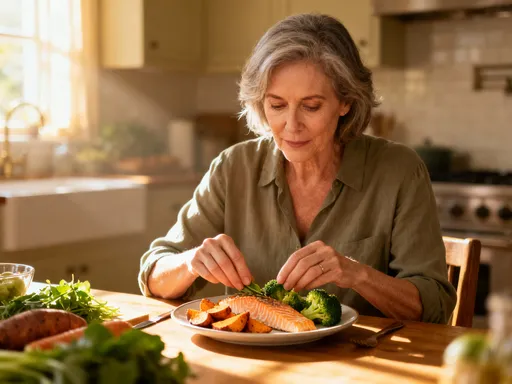
Nutrition remains a partner to exercise. While this article focuses on movement, it’s worth noting that adequate protein, calcium, and vitamin D are essential co-factors in bone remodeling. Sunlight exposure — 15 to 20 minutes daily — helps the body produce vitamin D naturally, supporting calcium absorption. Fall prevention is another critical component. Simple home modifications — removing throw rugs, improving lighting, installing grab bars — reduce the risk of injury, especially as balance naturally declines with age.
Bones are not static structures — they are living, responsive tissues that thrive on use. The message is clear: it’s never too early or too late to act. Whether you’re in your 30s building peak mass or in your 50s preserving strength, the right movements can make a lasting difference. This isn’t about achieving perfection, but about showing up for your body with intention. By choosing to move, challenge, and care for your skeleton, you invest in a future of independence, mobility, and confidence. Strong bones aren’t just built with milk — they’re built with motion, mindfulness, and daily commitment.